# When did amaro first appear in cocktail recipe books?
**URL:** https://spiritsandcocktails.community/t/when-did-amaro-first-appear-in-cocktail-recipe-books/992
**Category:** Cocktails and mixed drinks
**Created:** [March 3, 2025, 4:16pm UTC](https://spiritsandcocktails.community/t/when-did-amaro-first-appear-in-cocktail-recipe-books/992 "2025-03-03T16:16:19Z")
**Posts on this page:** 9
**Page:** 1
### Author:  [@fredyarm](https://spiritsandcocktails.community/u/fredyarm)
#### Post date: [March 3, 2025, 4:16pm UTC](https://spiritsandcocktails.community/t/when-did-amaro-first-appear-in-cocktail-recipe-books/992/1 "2025-03-03T16:16:19Z")
The earliest book that I can think of is William Schmidt’s _The Flowing Bowl_ in 1892 with recipes like the Appetizer L’Italienne with Fernet Branca.
Campari has a date of 1919 for the Negroni, but the Boulevardier beat it into books when it appeared in 1927. Anything earlier?
Any other amaro (I’m including aperitivos as well as digestivos) appear in print before Prohibition?
---
### Author:  [@martin](https://spiritsandcocktails.community/u/martin)
#### Post date: [March 3, 2025, 4:28pm UTC](https://spiritsandcocktails.community/t/when-did-amaro-first-appear-in-cocktail-recipe-books/992/2 "2025-03-03T16:28:04Z")
I think you’re right that it’s Schmidt, and Fernet Branca is going to be the big dog from the 19th Century and early 20th. A notable Americano recipe from 1913 specifies Fernet-Branca.
The early years of the 20th Century has a smattering of drinks calling for Boonekamp, krauterlikor, and Hostetters—none of those are Italian, but they’re at least comparable.
---
### Author:  [@fredyarm](https://spiritsandcocktails.community/u/fredyarm)
#### Post date: [March 3, 2025, 4:30pm UTC](https://spiritsandcocktails.community/t/when-did-amaro-first-appear-in-cocktail-recipe-books/992/3 "2025-03-03T16:30:42Z")
I knew about the Fernet Americano from David Wondrich’s talk at Tales back in 2016 (my notes: [cocktail virgin slut: :: all americano - italy and the cocktail ::](https://cocktailvirgin.blogspot.com/2016/08/all-americano-italy-and-cocktail.html) ).
I’d include any bitter liqueurs especially since I’m trying to gather my thoughts on the local amaro producers scene here in Massachusetts.
---
### Author:  [@martin](https://spiritsandcocktails.community/u/martin)
#### Post date: [March 3, 2025, 4:33pm UTC](https://spiritsandcocktails.community/t/when-did-amaro-first-appear-in-cocktail-recipe-books/992/4 "2025-03-03T16:33:02Z")
Calisaya was a thing. It appears in Schmidt, Kappeler, Johnson, Lowe, and more from the 1890s into the 20th.
---
### Author:  [@EvanD](https://spiritsandcocktails.community/u/EvanD)
#### Post date: [March 3, 2025, 6:26pm UTC](https://spiritsandcocktails.community/t/when-did-amaro-first-appear-in-cocktail-recipe-books/992/5 "2025-03-03T18:26:56Z")
This is related to something I’ve been trying to confirm lately without success—amaro as we know it basically existed in the nineteenth century, known as just “bitters,” right? And it was Angostura that created the “non-potable” loophole to survive Prohibition, thus creating the aperitif/non-potable distinction? So we should think of pre-prohibition bitters as a much more fluid, inclusive category?
---
### Author:  [@francois](https://spiritsandcocktails.community/u/francois)
#### Post date: [March 4, 2025, 10:03am UTC](https://spiritsandcocktails.community/t/when-did-amaro-first-appear-in-cocktail-recipe-books/992/6 "2025-03-04T10:03:00Z")
I don’t want to be pedantic here, but if by _amaro_ we mean _potable bitter liqueur_, Fernet Branca doesn’t qualify as it doesn’t have enough sugar to be a liqueur.
---
### Author:  [@Splificator](https://spiritsandcocktails.community/u/Splificator)
#### Post date: [March 4, 2025, 3:54pm UTC](https://spiritsandcocktails.community/t/when-did-amaro-first-appear-in-cocktail-recipe-books/992/7 "2025-03-04T15:54:58Z")
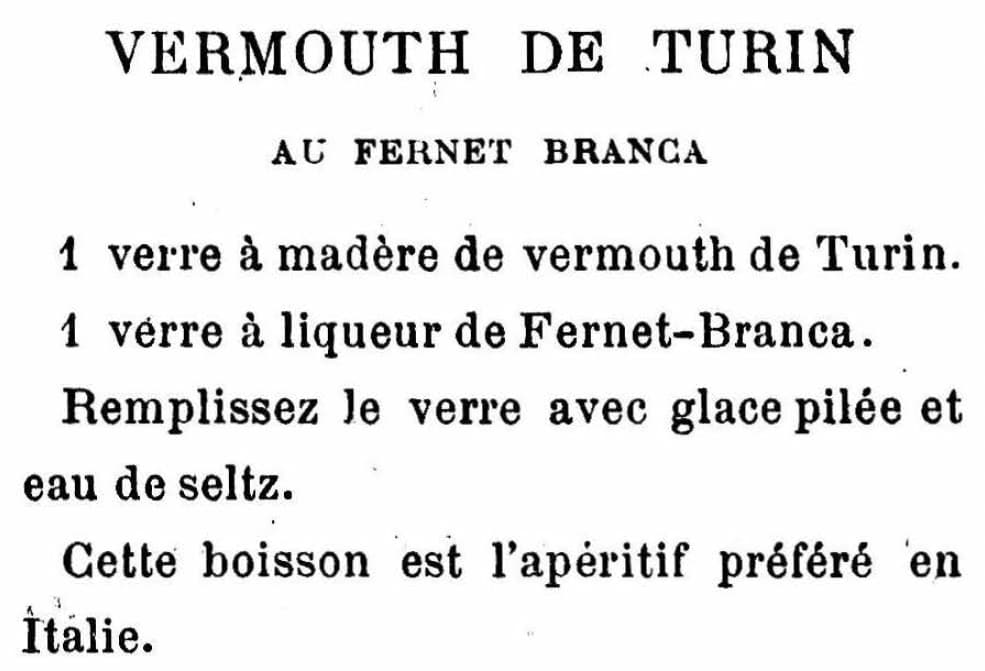
That’s a very French definition of amaro, I would say. Italian definitions of potability are perhaps looser. In Italy, Fernet is definitely an amaro in good standing, as are Novasalus and Centerbe, which are similarly more bitter than sweet. The Alpine bitters in general tend to be like that, while the southern Italian ones tend to be sweeter, but I would call those categories within the style.
For me, the first appearance of an amaro in a cocktail book is in Émile Lefeuvere’s 1889 _Les boissons Américains_, with this:
---
### Author:  [@martin](https://spiritsandcocktails.community/u/martin)
#### Post date: [March 4, 2025, 4:10pm UTC](https://spiritsandcocktails.community/t/when-did-amaro-first-appear-in-cocktail-recipe-books/992/8 "2025-03-04T16:10:16Z")
Cool! An even earlier Americano! I need to pay more attention to that book. I also spied a reference to “1 verre bitter Saillard” (p. 72)
---
### Author:  [@francois](https://spiritsandcocktails.community/u/francois)
#### Post date: [March 4, 2025, 5:56pm UTC](https://spiritsandcocktails.community/t/when-did-amaro-first-appear-in-cocktail-recipe-books/992/9 "2025-03-04T17:56:08Z")
> [@Splificator](#):
>
> That’s a very French definition of amaro, I would say. Italian definitions of potability are perhaps looser. In Italy, Fernet is definitely an amaro in good standing, as are Novasalus and Centerbe, which are similarly more bitter than sweet. The
Everything is looser in Italy!
More seriously, I was reacting to the use of the word liqueur in the thread. Both Braulio, Centerbe and other alpine digestives are above the 100g/l mark while Fernet definitely is not (iirc it hovers around 30g, which is historically high but very, very low).
Obviously if we’re being loose and including wine-based things such as Novasalus, we’re discussing the use of weird bitter Italian stuff in general and my point is moot 🤣