A question about the original 90-proof “red label” Ronrico sent me on a little dive. (I wish I could ping Steve Remsberg.)
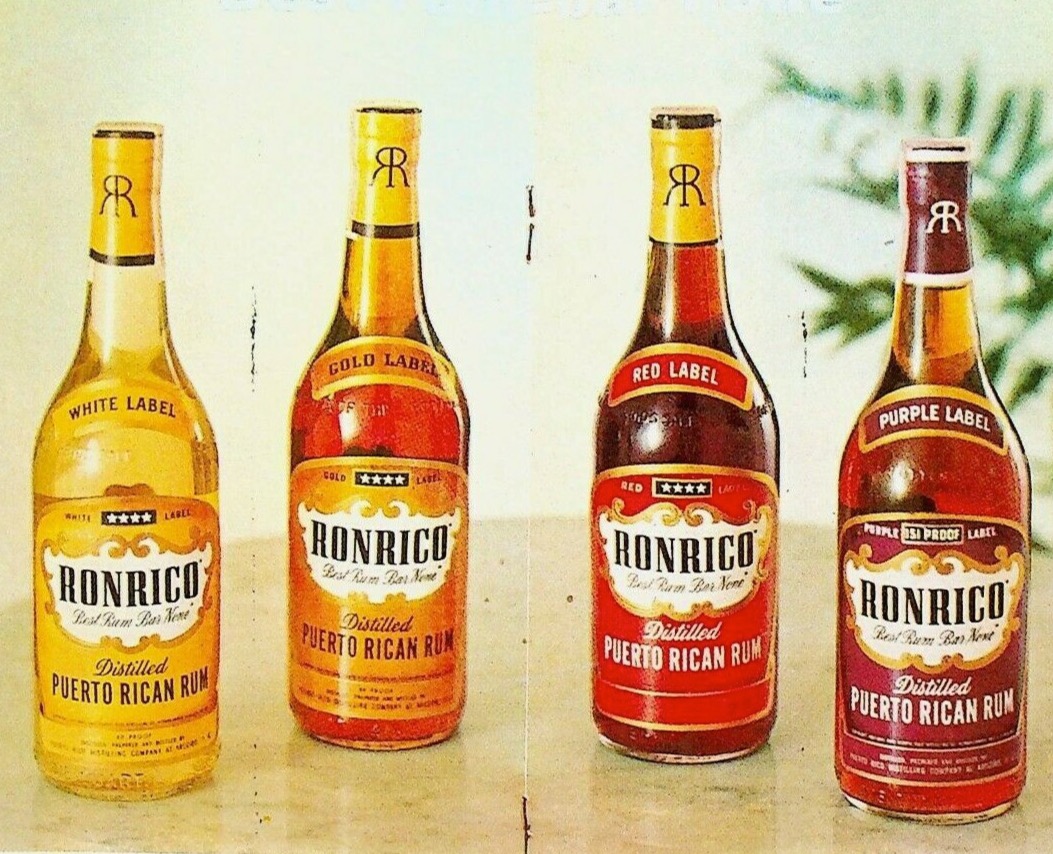
Ronrico launched in 1935 with four products, which they described thusly:
RONRICO WHITE LABEL-86 Proof-Light Bodied—
Pale golden in color—neutral in character-dry—delicate flavor
and aroma. Used in light tropical cocktails, also Gin recipes.
It is preferred by many in the mixture of Ronrico & Soda and as a straight drink.
RONRICO GOLD LABEL—86 Proof-Light Bodied—Darker than the White Label-slightly sweeter with a fruity flavor. Ideal as a straight drink—is used in many tropical recipes, as well as those calling for whiskey as a base.
RED RONRICO — 90 Proof — Dark & Heavy Bodied —Stronger than the light rums, but driest of the heavy bodied class. Ideal for those who want a more definite rum character. Used in such sturdy recipes as Planters’ Punch, Swizzles, etc., cold weather concoctions, such as Hot Toddies, Tom & Jerries, etc.
RONRICO SPECIAL—151 Proof—Similar in character, flavor and taste to Red Ronrico, but decidedly stronger. Ideal in culinary recipes; flaming dishes, and as a partial ingredient in some mixed drinks-particularly the now famous ZOMBIE.
Bottle photo consistent with the early 1940s packaging:
The former two products are obviously filtered and gold Puerto Rican rums, respectively, and the latter two products appear to be a stab at a “punch rum” in two strengths, but those are presumably still Puerto Rican rums, not some blend of imported rums. Based on the frequency of vintage anything pertaining to these products, the red label was the least popular by a fair margin. It’s not clear to me the red label survived into the 1960s. Perhaps it wasn’t compelling?
If anyone has further info, I’m interested. I can’t help wonder whether it might have been a macerated rum like Ron de Barrilito?
Ronrico’s went through a lot of packaging changes by era and market. There’s the 1930s, 1940s and maybe some of the 1950s which were probably the brand’s heyday, during which all four original products survived, and were, apparently, successful. Somewhere in the 1960s, one sees new, more generic packaging, and a market repositioning.
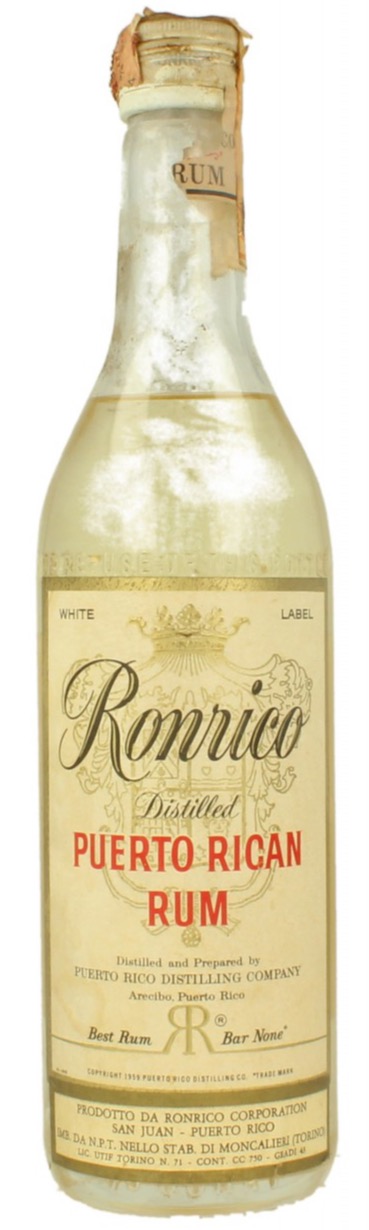
One interesting development is some bullshit creep. Here’s a 1959 bottle that suddenly sports a Spanish royal crest in the background:
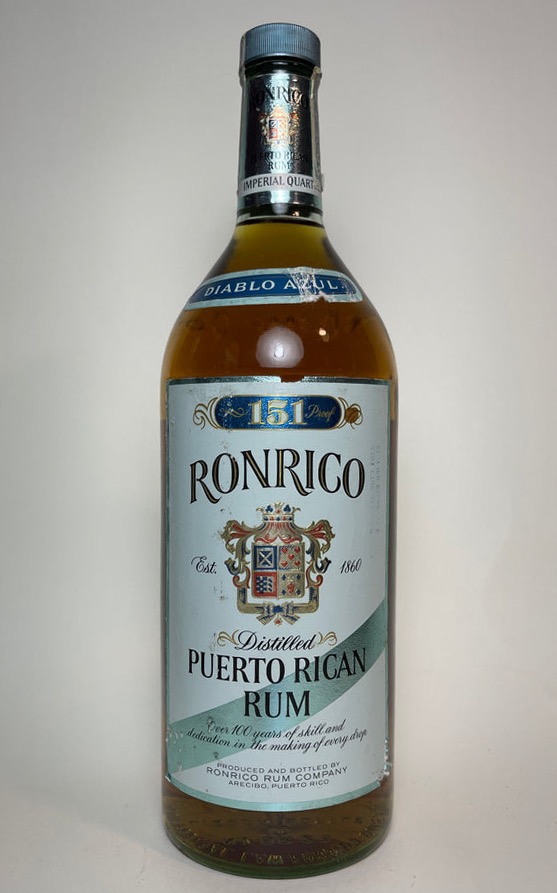
By the 1970s, the crest is a central element on both the label and neck, and “Est. 1860” has started appearing on the label.
Ronrico marketing copy since this era sometimes refers to an 1889 royal license, but that business pertained to 19th Century distilleries in Arecibo, Puerto Rico, that consolidated in 1911 as Puerto Rico Distilling Co. Ronrico itself was, again, a 1935 joint venture between Puerto Rico Distilling Co. and Florida Cane Products, Inc. Moreover, the actual distillation, aging and blending of Ronrico was clearly a moving target by the 1960s—it’s just a rectifier brand with nothing specific behind it.