NYT article on Attaboy unionizing efforts.
3 Likes
I find the GoFundMe for the union to be… weird.
Is this just a generational thing?
I kinda think so. It’s just the most common way to crowd source funds at the moment. I’ve seen GoFundMes for everything from cancer treatment to book launches. I don’t think bake sales have the same reach these days.
From that thread, my guess is that the bar will implode within a year (and not for elevated costs due to unionizing).
Another post on the recent firing.
2 Likes
Sammy Ross made a “personal” post on Instagram last night publicly addressing this particular saga. It’s a ten image gallery of white text on a black background and I’m not in the mood to transcribe it. Perhaps the regular text exists elsewhere?
Under the circumstances, the post should be interpreted as public relations and was probably vetted by his attorney. (That would be the smart thing to do.)
Regardless, as an entrepreneur of over thirty years, I personally empathize/sympathize with everything he says about his journey and personal investment in Attaboy, and all the emotions. I’ve been there, myself, over and over through myriad ups and downs. But in the end, I think the “500-square foot bar” stuff and the why-cant-we-just-talk-it-out stuff just reinforces the claims that he was out of touch.
2 Likes
I got you @martin . Here’s Sam’s post:
I’ve spent the last few months cycling through a range of emotions that I still haven’t been able to fully make sense of. Anger. Frustration. Sadness. Fear. Mostly confusion. I feel blindsided. What has been difficult for us isn’t that people have the legal right to organize. They do, and I respect that. What’s been difficult is that I genuinely never saw any of this coming. I don’t remember a moment where I thought Attaboy was on the verge of a labor dispute. I don’t remember a moment where anyone around me felt unheard. Maybe that’s on me. But the truth is that when all of this became public it felt less like a disagreement and more like discovering that everyone else had been reading a different book than the one I thought we were all in.
The entire experience has felt surreal, and maybe that’s because Attaboy has never felt like a business to me in the way people normally mean that word. I came to the US with almost nothing. At the time, most of my friends and colleagues in Australia were going to London. But I had become completely obsessed with New York. There was something about the cocktail culture here that felt different. More thoughtful, more intentional, more romantic. And at the center of all of it, at least in my mind, was Sasha Petraske. I had a dream that sounds embarrassingly naive now because it was so specific. I wanted to work for Sasha. That was it. That was the whole dream. So I showed up in New York and did everything I could think of to become good enough. I cold called Milk & Honey and Sasha picked up. I was young enough to confuse persistence with strategy. Eventually Sasha agreed to meet me, and I remember sitting across from him and telling him everything: my hopes, my ambitions, my dreams, the whole embarrassingly earnest thing. Somehow, for reasons I still don’t entirely understand, he gave me a chance.
The next decade of my life unfolded inside those walls. learned hospitality from him. I learned what excellence looked like. I learned how much care could be hidden inside seemingly insignificant details. I met my best friend and eventual business partner Micky there. I found a community. I found purpose. I found an identity. When people talk about Attaboy, they talk about a business. But when I think about Attaboy, I don’t think about a business, I think about my life. I think about the place where I became who l am.
When Sasha eventually decided to move on, he structured a deal that allowed Micky and me to become stewards of what he built. That word matters to me because it’s genuinely how we viewed ourselves. We never felt like owners in the traditional sense. We weren’t investors who spotted an opportunity. We weren’t executives looking to maximize returns. We were bartenders who had been entrusted with something sacred. We inherited a responsibility to preserve a philosophy, a culture, and a legacy that had profoundly shaped us. The reality is that neither Micky nor I were trained for any of this. We weren’t professional managers. We were bartenders. One day we were bartenders and the next day we were responsible for preserving one of the most influential bars in the world. Nobody teaches you how to make that transition. Nobody hands you a manual on leadership, conflict resolution, labor relations, organizational design, or small-business management. We were immediately promoted beyond our core competencies and then spent years trying to figure it out as we went.
Our approach was probably naive, but it came from a sincere place. We tried to create the place we would have wanted to work. We tried to take care of people the way we wished people had taken care of us. We tried to be flexible.
We tried to be accommodating. We tried to say yes whenever we could. We tried to build a home and convince a handful of other people to help us build it. Part of what has made this so emotionally disorienting is that I increasingly feel like I’ve become a stranger inside my own story. For most of my life identified myself as a bartender and part of the crew. What keeps me awake isn’t criticism.
It’s the possibility that despite all of our intentions, despite all of our efforts, despite all of the years spent trying to build a place that felt collaborative and humane, the people around us somehow experienced something completely different. That possibility hurts more.
What’s made it even harder is that it often feels like there is no acceptable way to talk about any of this publicly. If we stay quiet, people assume silence means guilt and the vacuum gets filled by assumptions and narratives we have no ability to shape. If we speak, we’re accused of being defensive or anti-union. If we express sadness, we’re told we’re centering ourselves. If we explain our concerns, we’re told we’re making excuses. If we challenge accusations, we’re told we’re attacking employees. So you find yourself in this bizarre position where your own life is being discussed publicly while simultaneously feeling like you’re not entirely allowed to participate in the conversation. That loss of agency has been hard.
The other thing that often gets lost is the actual scale of what we’re talking about. Attaboy occupies an enormous place in cocktail culture, and I’m incredibly grateful for that and the support that this little place receives. But sometimes I think the mythology has become much larger than the reality. Attaboy is a 500-square-foot bar. One room.
On an average day we might do 4-6 thousand dollars in sales. Nearly half of that goes directly to labor. Another quarter goes to product costs. Then there’s rent, insurance, utilities, licensing, repairs, maintenance, compliance, and every other expense that comes with operating a bar in New York City. For years Micky and l operated with a very simple goal: break even plus make ten percent, and protect the bar. Nobody is getting rich. We are trying to preserve something we love.
What has made this process particularly frightening is that we now find ourselves responsible for navigating a system we know almost nothing about. Suddenly we’re spending enormous amounts of time talking to lawyers, consultants and advisors simply to understand what the rules are. I’m not saying those systems don’t have a purpose. Clearly they do. I’m saying they’re expensive, they’re complicated, and for a tiny independent business every dollar spent navigating the process is a dollar that can’t be spent on staff, guests, improvements, repairs, education, or any of the countless things that make a workplace better.
Sometimes it feels like all process and no outcome.
Sometimes it feels like we’ve lost control of our own story. Sometimes it feels like we’re no longer steering the ship and are instead trying to decipher the instruction manual while already out at sea.
And underneath all of that sits the fear I rarely talk about publicly. The fear isn’t criticism. The fear isn’t shitty comments directed to us on Instagram. It’s the possibility of losing the bar itself. Because if the burden of managing all of this eventually exceeds our ability to sustain the business, then we lose more than a business. We lose 134 Eldridge Street. We lose the place where Sasha’s ideas took root. We lose a piece of our shared history. And llose the place that gave my own life meaning. The thought that I could somehow become the steward who failed to protect what was entrusted to him is devastating to me in a way that I struggle to articulate. If I become the person responsible for that legacy disappearing, I honestly don’t know how I would live with that.
So yes, I find myself oscillating between anger, frustration, sadness, confusion and fear. But beneath all of it is grief.
Grief for a relationship I thought existed.
Grief for trust that now feels broken.
Grief for the feeling that somewhere along the way we stopped talking to each other. Because regardless of where anyone stands on unions, ownership, labor or politics, I never imagined that after all these years we’d end up communicating through lawyers. I thought we’d just talk to each other.
2 Likes
One of my friends posted about the Attaboy situation and the Walrus & Carpenter strike in Seattle. The owners of the Walrus & Carpenter released their P&L (I did not have permission to open it nor the open letter) to counter the strikers’ demands. Numbers speak better than the emotional dump Sam Ross did. It seems like the ghost of Sasha the symbolism of 134 Eldridge is used as emotional leverage.
1 Like
I too feel for Sam and Michael. I wonder if the multiple business endeavors just opened a blind spot for them that allowed for there to be a genuine disconnect between themselves and the staff at Attaboy NYC?
But I also feel for the staff, who care enough about the bar to try and stick with it but also improve their own working conditions. In response, union-busting lawyers have been retained, there’s was a firing that could be seen as retaliation, and a lot of money spent.
If I may be so bold, maybe they should all drop the lawyers? Open and go through the finances of the bar with the union. Do what you can to compromise. Set aside a few hours each month for union meetings.
I think it’s tempting to generalize all unionization efforts as a battle, a struggle with a winner defeating a loser. In some cases it is, but in the intimate, small-scale context of Attaboy NYC, it can be more about talking, negotiating, and compromise.
2 Likes
Highly plausible:
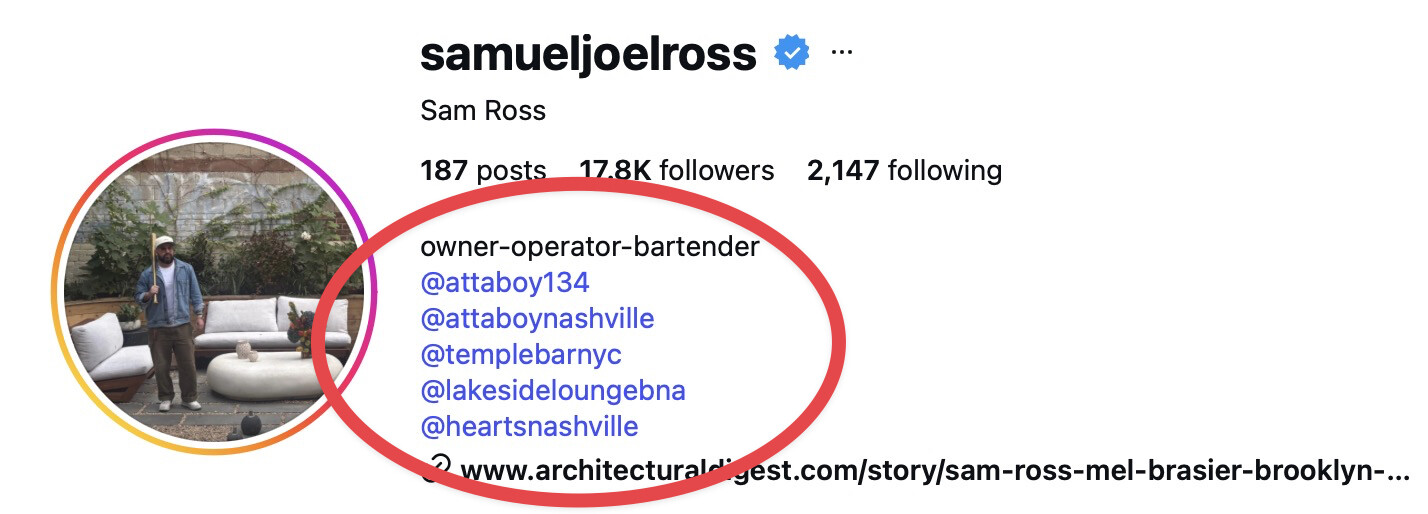
There’s maybe some question about which numbers to use. A single owner-operated bar is one thing. Five bars is starting to look like a restaurant group, even if it’s not structured that way. (I have no idea how Sam’s businesses are structured.)
1 Like
Once invoked, lawyers cannot be dispelled. To a lesser extent, accountants are a similar force. I have a lot of feelings in this area I have resisted sharing because they are not strictly relevant. Let me just say that all of us operate with self-concepts that are proven to be outdated, and sometimes violently so.
3 Likes
I bet that if a group of lawyers had to listen to me ramble on about what orange liqueur should go in what cocktail or the funk scene in Minneapolis ca. 1980, they would disperse.
Jokes aside, you’re right. All we can do is wait and hope cooler heads prevail.
1 Like