Irritated that I wasn’t easily locating the text that first described the Champagne Cocktail, I dug it up and provide it here.
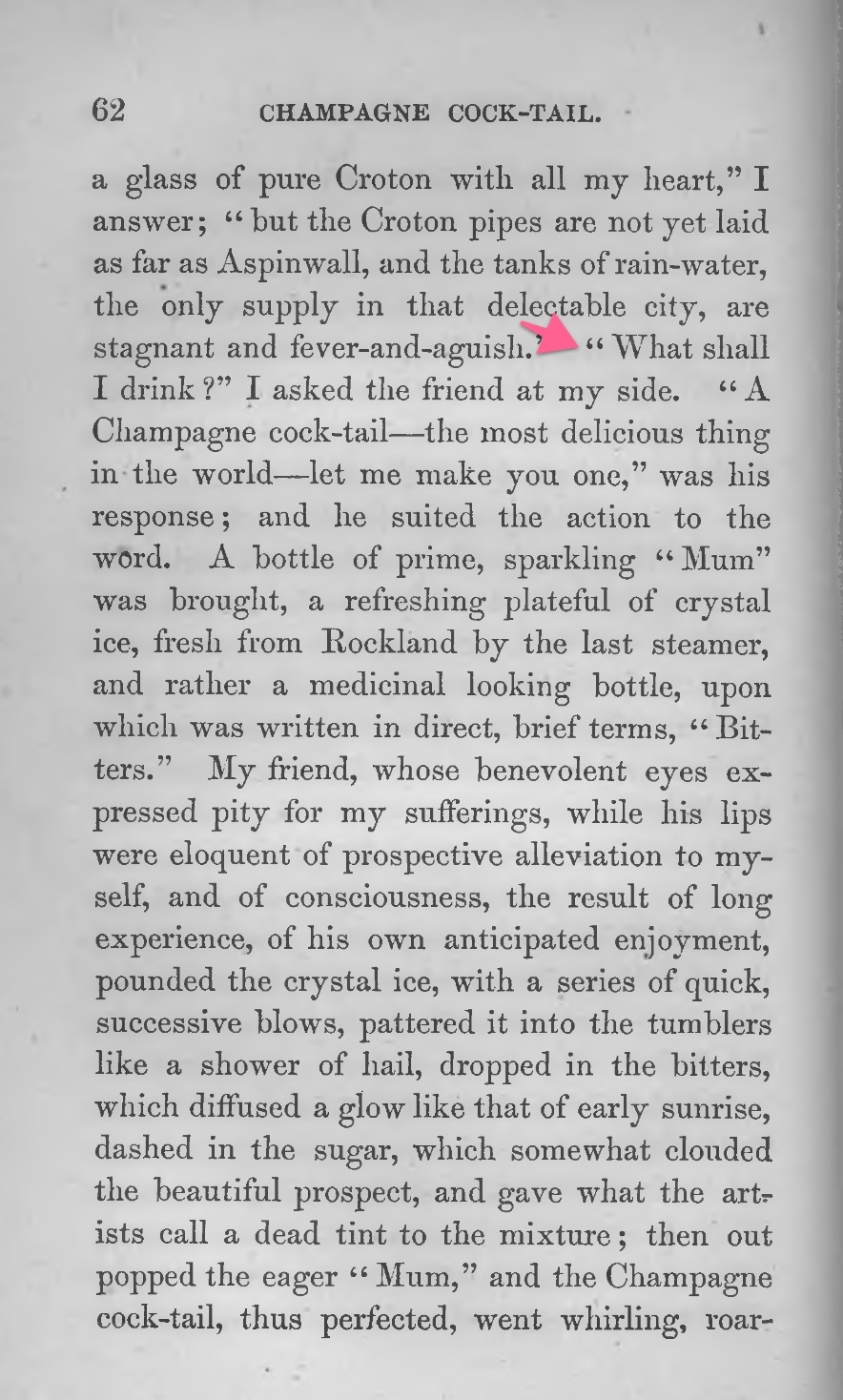
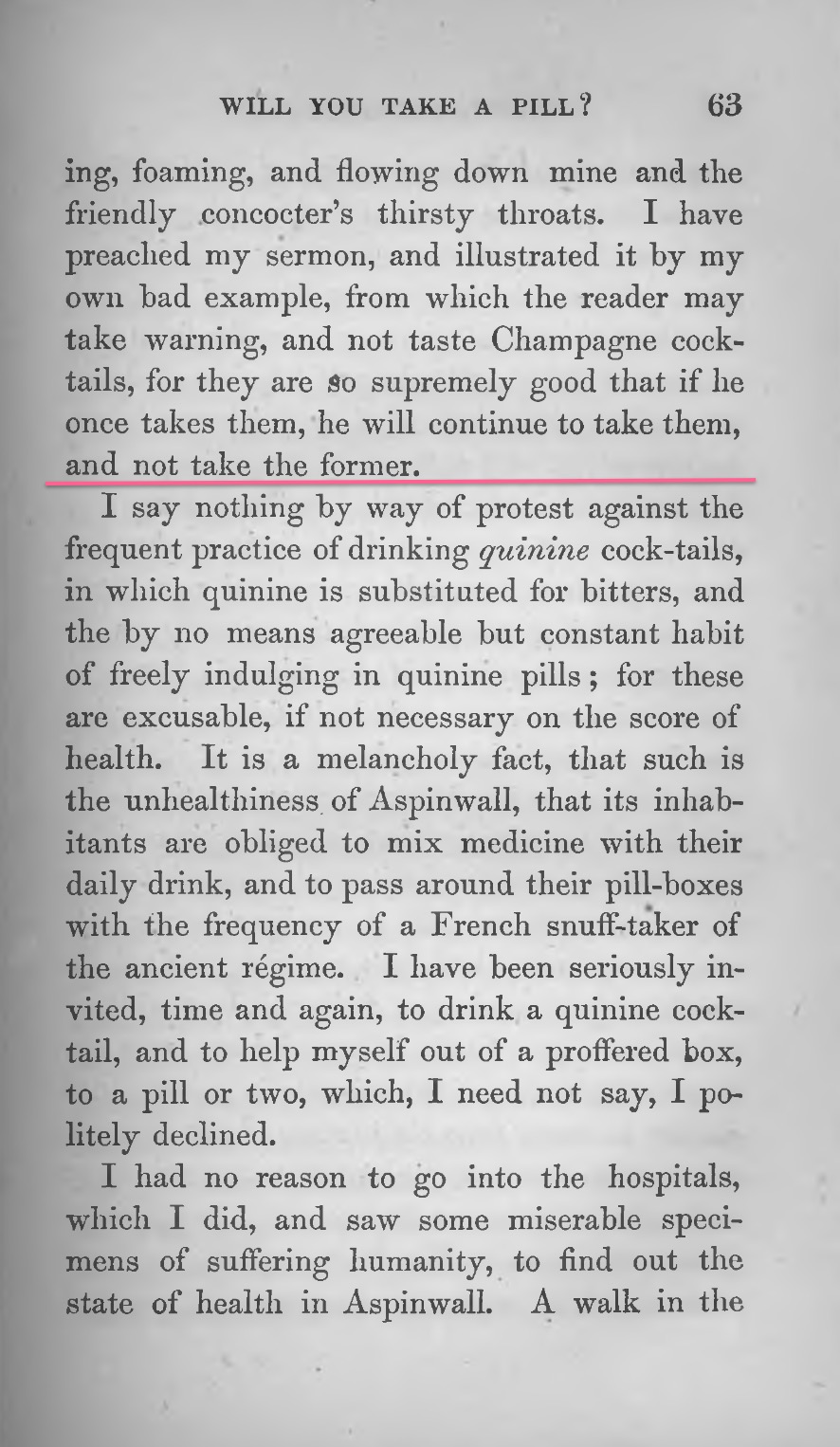
This is pages 62 and 63 of Panama in 1855, a travelogue by Robert Tomes, published by Harper & Brothers, New York, in the same year. A lot of champagne is consumed along the way, and brandy, and sherry, and some other stuff. It’s a colorful 246 pages.
“What shall I drink?” I asked the friend at my side. “A Champagne cock-tail—the most delicious thing in the world—let me make you one,” was his response; and he suited the action to the word. A bottle of prime, sparkling “Mum” was brought, a refreshing plateful of crystal ice, fresh from Rockland by the last steamer, and rather a medicinal looking bottle, upon which was written in direct, brief terms, “Bitters.” My friend, whose benevolent eyes expressed pity for my sufferings, while his lips were eloquent of prospective alleviation to myself, and of consciousness, the result of long experience, of his own anticipated enjoyment, pounded the crystal ice, with a series of quick, successive blows, pattered it into the tumblers like a shower of hail, dropped in the bitters, which diffused a glow like that of early sunrise, dashed in the sugar, which somewhat clouded the beautiful prospect, and gave what the artists call a dead tint to the mixture; then out popped the eager “Mum,” and the Champagne cock-tail, thus perfected, went whirling, roaring, foaming, and flowing down mine and the friendly concocter’s thirsty throats. I have preached my sermon, and illustrated it by my own bad example, from which the reader may take warning, and not taste Champagne cock-tails, for they are so supremely good that if he once takes them, he will continue to take them, and not take the former.
(Also, the follow-up paragraph on page 63 about quinine is not uninteresting.)
I love the description of the ice (“fresh from Rockland”) “pattered into the tumblers like a shower of hail”…but ICE in a Champagne Cocktail is rather startling to my modern eye!
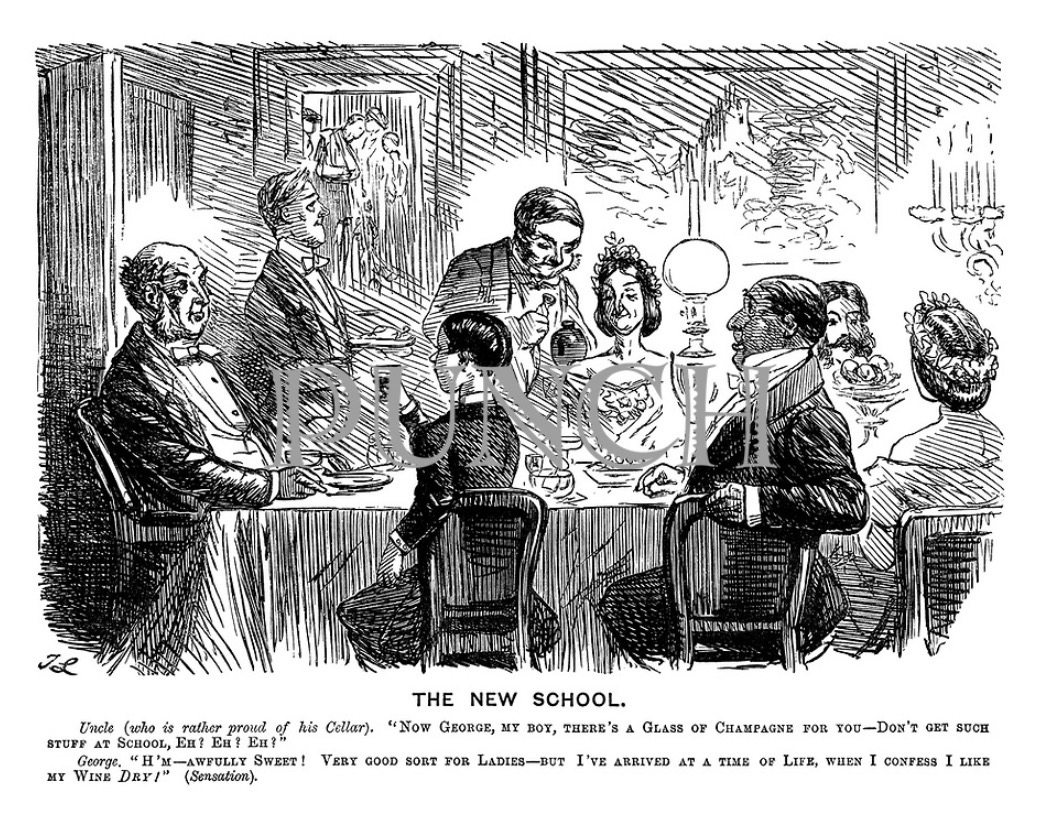
The details are still a little vague to me, but my understanding is the Champagne Cocktail emerges during a period when Champagne itself is undergoing a gradual transformation. So, the mid-19th Century Champagne Cocktail (as you see here and in Jerry Thomas) is iced, and presumably quite sweet, because the Champagne of that era is sweet and less intensely effervescent. By the end of the 19th Century, fizzy brut is what is popular (as it remains today) and so the ice drops out.
Interesting, and makes perfect sense—although “whirling, roaring, foaming” does sound like there’s a bit of bubbling going on. The bitters might be doing that, I suppose.
I pulled out my Embury for fun, and love what he has to say ca. 100 years on:
“Why some people rave about the Champagne Cocktail is a complete mystery to me. The only known reason for regarding it as ‘ultra-ultra’ is the fact that champagne is expensive. From every point of view, other than cost, this cocktail is a decidedly inferior drink, and no true champagne lover would ever commit the sacrilege of polluting a real vintage champagne by dunking even plain sugar—much less bitters—in it. So, if you must, on occasion, serve this incongruous mess just for the sake of ‘putting on the dog,’, then, in the name of all that a true lover of the grape holds sacred, use a cheap domestic champagne or even an artificially carbonated white wine. The cocktail will be just as good, the burden on your pocketbook will be less, and you will have refrained from desecrating the memory of Dom Perignon, the Benedictine monk who, by accident, first discovered champagne.”
Embury has never much resonated with me. Not that he’s wrong that the drink can be made with less precious sparkling wines, although I would still prefer a Cremant or better cava—something with yeasty secondary fermentation—over a merely carbonated wine.
I admittedly haven’t gotten around to trying it, but I have long suspected that there might be something to the earlier iced style that should be revisited, probably with a non-brut wine.
The time is ripe, as it seems like there’s been a resurgence of sweet champagnes on the market in the last five years:
I assume the champagne houses are mindful of the decline in wine sales, and are trying to lower the barrier to entry by creating sweeter wines explicitly marketed to be served over ice.
I’m not sure which historical “transformation” you’re alluding to. One development I think is significant is the systematic understanding of how sugar affected the secondary fermentation, beginning with the publication of François’s treatise in 1837. Champagne produced before this development may not have been different, but it certainly became more consistent, and the rate of bottle breakage during manufacture plummeted, allowing the sparkling white style to drive any remaining table wines out of local production.
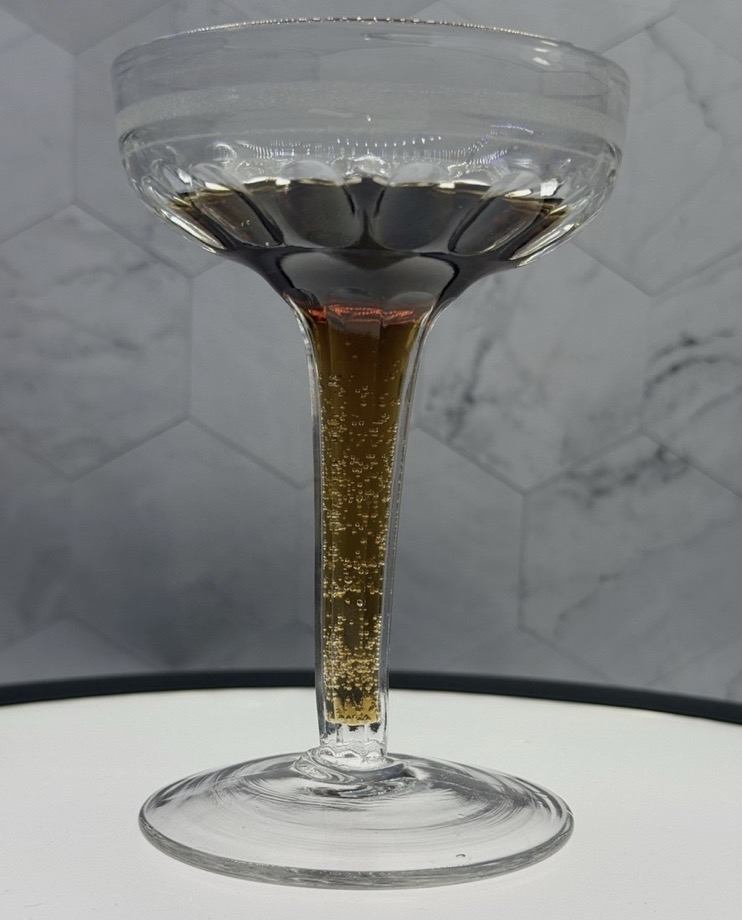
Apropos of champagne cocktails, rather than Champagne Cocktail: I got a couple hollow-stem champagne coupes after seeing a recipe calling for them specifically. You can imagine: fill the stem portion with say, strawberry liqueur, and fill the bowl with champagne. While trying to retrieve the specific recipe, I started to see how many champagne cocktail recipes could be construed in this “mignon boilermaker” [French car bomblet?] fashion. I read through plenty of articles about the virtues and associations of the tulip, flute, and coupe, but I haven’t found anything indicating when and where cocktails on this build were popular, and when a thoroughly mixed champagne cocktail should be assumed.