Andrew Bohrer posted on Bluesky this morning. What he wrote struck a chord for me (as someone inside the New York City bubble). Across eleven short posts, Andrew touches on so many aspects of one drink and its context, capturing or alluding to many resonant facets of the status quo. I am reproducing the thread here, where it is less ephemeral and fragmented.
The state of the corporate cocktail based on the one drink I had yesterday:
Yuzu Green Chartreuse Margarita $18 from a chain ramen place in Midtown NYC.I ordered it because I knew if every ingredient made it into the glass it’d be a C+ at worst.
And it was a B.
Here’s why:
Cost: $18 for a cocktail with cut ice, yuzu, Green Chartreuse, in Midtown, and where minimum wage is $17- pretty tight.
$18 gets you a shaken Manhattan with ice chips and 3-year-old vermouth in this town.
The base was Hornitos which is a big fucking miss.
It’s not that it’s bad (it’s quite a comprise) but considering the other ingredients and presentation it would be like if a fine dining restaurant started a dish with a pre-cooked Sysco chicken breast.
Green Chartreuse in a menu cocktail?
Must be tired from flexing.
I saw the bar had yellow and green. I mean, I’d rather have additive free tequila and génépi for half the price but I respect the effort.
The Chartreuse was very subtle. I would have doubled it.
But- the fact that it was subtle is very Japanese.
I think my style of cocktails for the Japanese palate makes me seem like Guy Fieri.
Cocktail culture isn’t a monolith.
Yuzu infused and Yuzu honey? No it wasn’t. And if it was, do it again or just spritz the top with yuzu oil. Yuzu was not discernible in any way.
Yuzu is too beautiful a flavor to be lost as a buzzword.
Garnishes while trendy, were on point.
Clown on the matcha economy all you want but the matcha salt rim was perfectly balanced, executed, and enhanced the drink. Earthy, salty, umami, only on the outside of the glass done with machine precision.
13 out of 10. This is how it is done.
The ice was crystal clear, fit the glass, and was slightly irregular in a way I greatly appreciate.
A cloudy big cube is a cold hamburger.
A cube bought from a supplier that doesn’t fit the glass is a child in their parent’s suit.
By literally one second, the appetizer beat the cocktail to the table. That’s, uh, well, could be worse.
The restaurant was busy.
There were at least 8 cooks to 1 bartender. So, that bartender was holding it down, but it’s a sin for food to beat drinks.
But here’s the thing, when I started in this business, if a bartender at a ramen chain made a shiso mojito with Bacardi, sour mix, and watery ice they’d put them on a magazine cover.
This place was ripping on a Sunday afternoon, guest were happy, and while I can dissect flaws: the bar is raised.
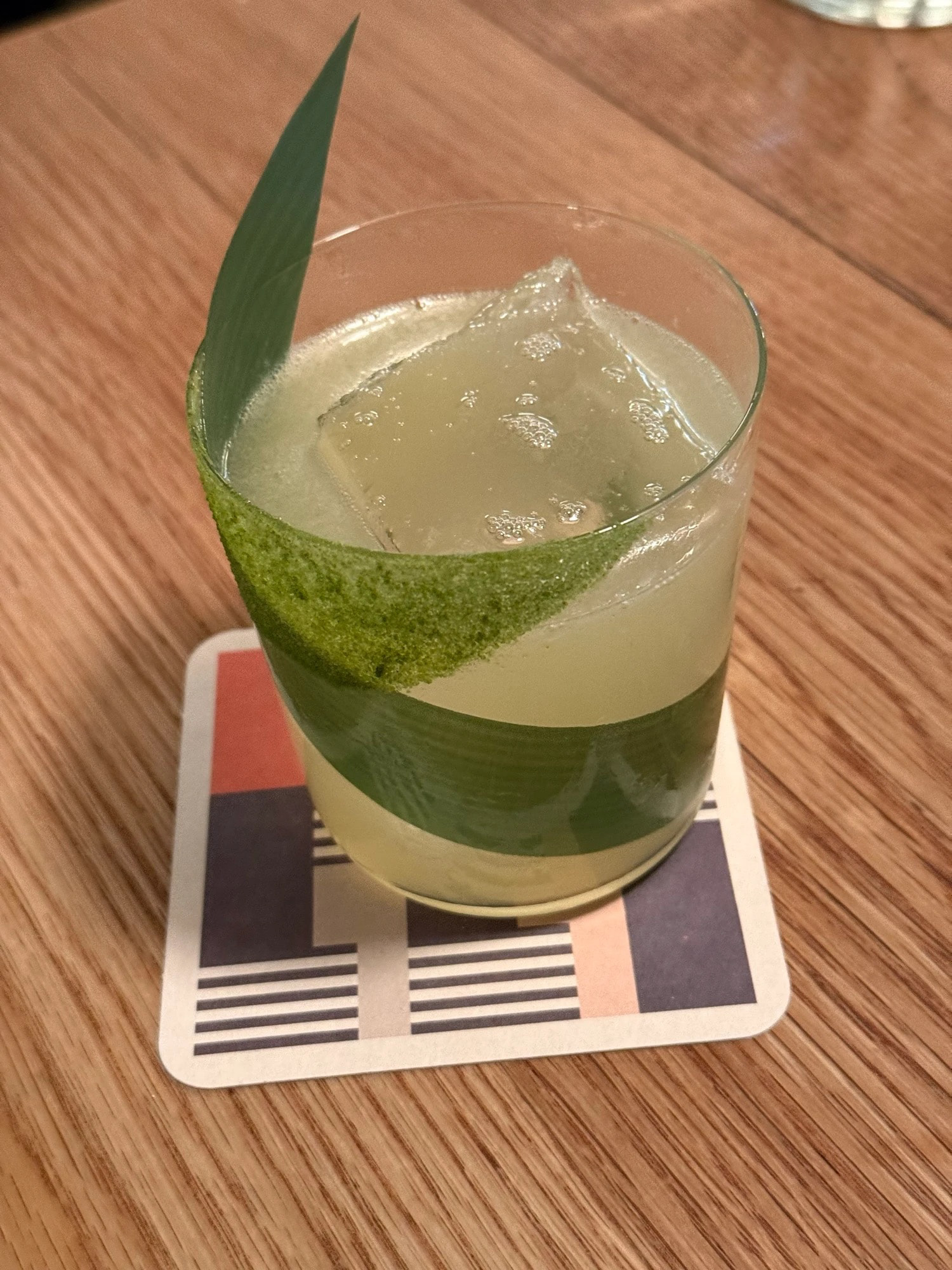
Perhaps this solitary testament cannot possibly encapsulate everything, but it feels like a great start. An entire book could be developed from this germ.
Thoughts?